What Is a Parking Ecosystem, and Why Does It Matter?
Product
September 22, 2026
Parking is usually treated as a set of separate jobs. One system takes payments, another reads number plates, a third handles permits, and someone eventually exports a spreadsheet to see how it all went. Each piece works on its own terms, but they rarely talk to each other.
A parking ecosystem takes a different approach. It treats payments, enforcement, permits, data and driver support as parts of one connected system, so a change in one area is visible and useful in the others.
The problem with fragmented parking
Most car parks grow their technology piece by piece. They install a barrier system, add pay machines later, and bolt on an app when drivers start asking for one. Every addition solves a real problem, but the gaps between the systems create new ones:
Data sits in silos: Payment records don’t match camera records, so it’s hard to see what is really happening on site.
Drivers get penalised by mistake: A permit holder whose details never reached the enforcement system can receive a charge notice they shouldn’t have.
Staff time is lost to workarounds: Manual checks, reconciliations and intercom calls fill the gaps between tools.
Hardware becomes a weak point: Barrier faults and broken kiosks mean queues, complaints and lost income.
What is the Hozah Ecosystem?
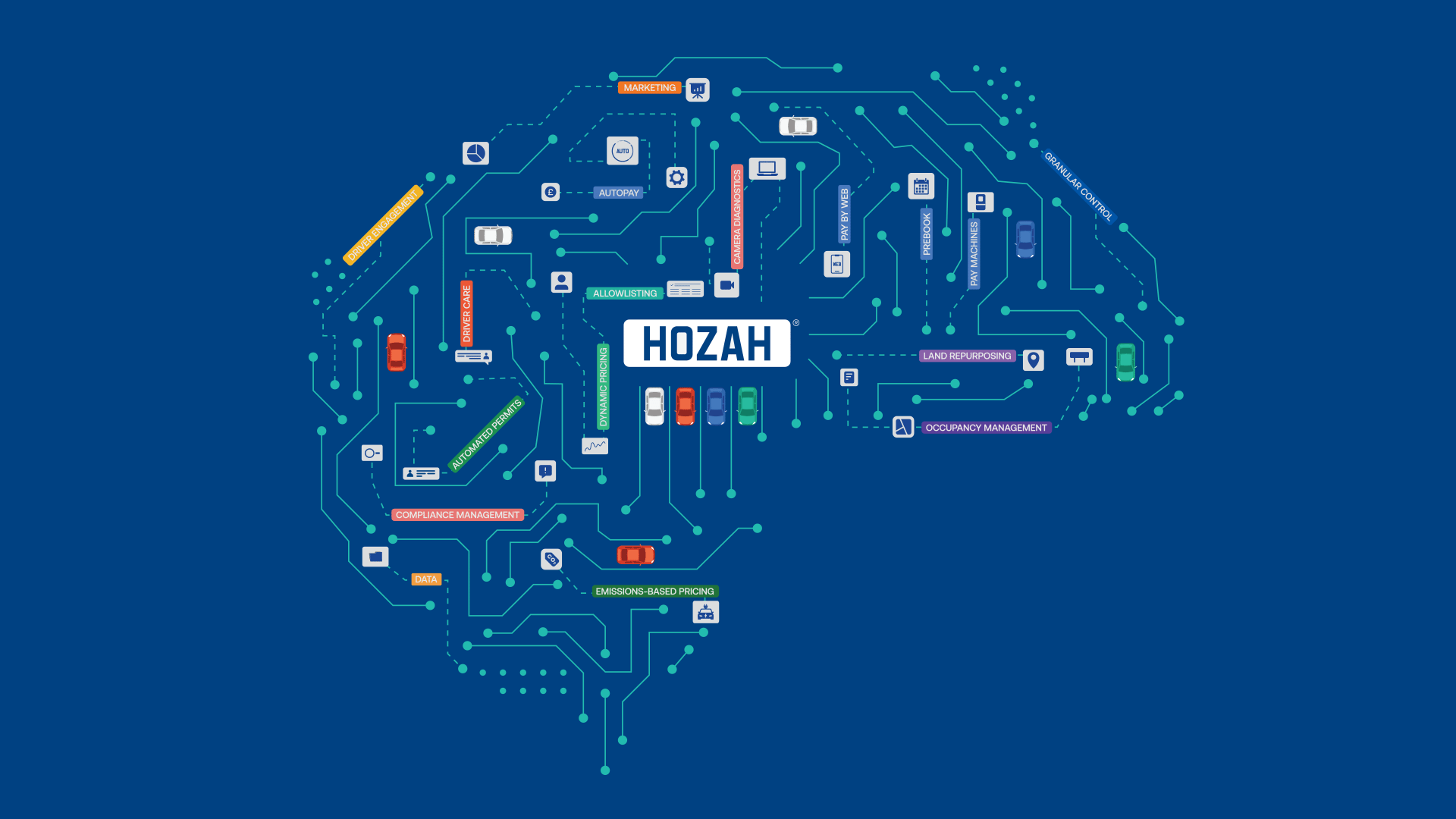
The Hozah Ecosystem is a fully connected suite of technologies that manage every stage of the parking journey.
It includes:
Compliance & enforcement automation
Real-time camera diagnostics
Dynamic pricing & permit management
Hozah AutoPay and PayByWeb payments
Advanced data & insights
Full operational control through the Hozah Console
Every module is purpose-built to work together, meaning no integration gaps, no third-party delays, and no inconsistent data. Just a single, unified system that runs smoothly, across one site or your entire estate.
In an ecosystem, the pieces share information as they work. There are five main layers.
Recognition: ANPR (automatic number plate recognition) cameras identify vehicles as they arrive and leave. This removes the need for tickets and barriers, and it underpins almost everything else.
Payments: Drivers can pay in whichever way suits them. With an automatic system such as Hozah AutoPay, a driver registers once, and the cameras recognise the vehicle and charge the right fee on exit. Others may prefer a Pay-By-Web link with no account, a pre-booked space, or a traditional pay machine. All of these feed the same records.
Permits and pricing: Permits, allowlists (approved vehicle lists) and tariffs are managed digitally and recognised by plate. A staff member, tenant or resident with permission to park is recognised automatically rather than needing a physical permit. Pricing can vary by time of day, demand or user group, and can even reflect vehicle emissions.
Compliance: Enforcement uses the same data as payments and permits. Because it checks against one source of truth, fewer charge notices are issued in error, which means fewer disputes and complaints.
Data and support: Every session adds to a picture of occupancy, dwell time, repeat visits and peak periods. Driver support and marketing draw on that same picture instead of guessing.
The key point is that no layer is useful in isolation. Cameras without payment integration only count cars. Payments without permit data lead to mistaken charges. Data without enforcement is just reporting.
The Hozah Console
Different sites, same pattern
The approach holds regardless of scale. An independent landowner gets the same connected data as a national portfolio; a residential estate uses allowlisting to control access the way a shopping centre uses it to manage turnover. What changes is the configuration, not the underlying system.
Why the shared data matters most
Connected systems change what an operator can do with a car park, because decisions can be based on what is actually happening on site.
Occupancy and dwell-time data show which areas are under-used, which can point to space that could serve another purpose, such as EV charging or a shared-mobility hub.
Pricing can respond to demand: Encouraging quicker turnover at peak times only works if you can see when the peaks are.
Corporate and group parking gets easier: Options such as season tickets, pay-per-use accounts and shared space plans depend on knowing who parked, when and for how long.
Marketing becomes measurable: With usage data in hand, an event promotion or loyalty offer can be tested and adjusted.
Drivers also benefit. When registration, payment and support connect properly, most of the friction disappears: no hunting for change, no app download, no queue at the barrier.
What it looks like in practice
The value of this approach shows up best on real sites, and they vary widely:
Grosvenor Shopping Centre replaced ageing barriers and reported a 20% uplift in parking revenue, 15% longer dwell times and an 8% increase in footfall. The rollout took three weeks.
Wellgate, Dundee moved from a barrier-based car park with frequent faults to free-flow ANPR and saw a 22% revenue uplift in the first three months.
Bournemouth University rolled out digital permits and AutoPay across 16 campus car parks, with instant permit issuing and less admin time.
The Wrekin, Shropshire, is a remote, unstaffed nature reserve that had struggled with unreliable kiosks. It saw a 34% year-on-year rise in parking revenue, with the surplus reinvested into conservation.
The sites differ enormously, from a city centre to a hilltop reserve, yet the pattern is similar. Removing manual steps and connecting the data tends to improve both the driver experience and the operator’s results.
Questions worth asking of any parking system
Whichever provider you use, a few questions help show how connected a setup really is:
Do payment, permit and enforcement data live in the same place?
If a driver’s permit changes, how quickly does enforcement know?
Can you see occupancy and dwell time without exporting reports from several tools?
Who do drivers contact when something goes wrong, and can that person see their history?
How much of the system depends on hardware that can fail on site?
The answers show quickly whether you have a system or a collection of tools.
The bottom line
A parking ecosystem isn’t a feature or a product. It’s a way of organising parking so that the parts work together. The benefits show up in fewer errors, less admin, better information and a smoother experience for the people using the space.
The Hozah Ecosystem is one example of this approach. Some services and features are available only at selected sites.
Get the Full Brochure to Find Out More!
For landowners who want deeper technical detail, including permit functionality, system integrations, and how the platform works within existing operations, discover the full breakdown in our brochure.